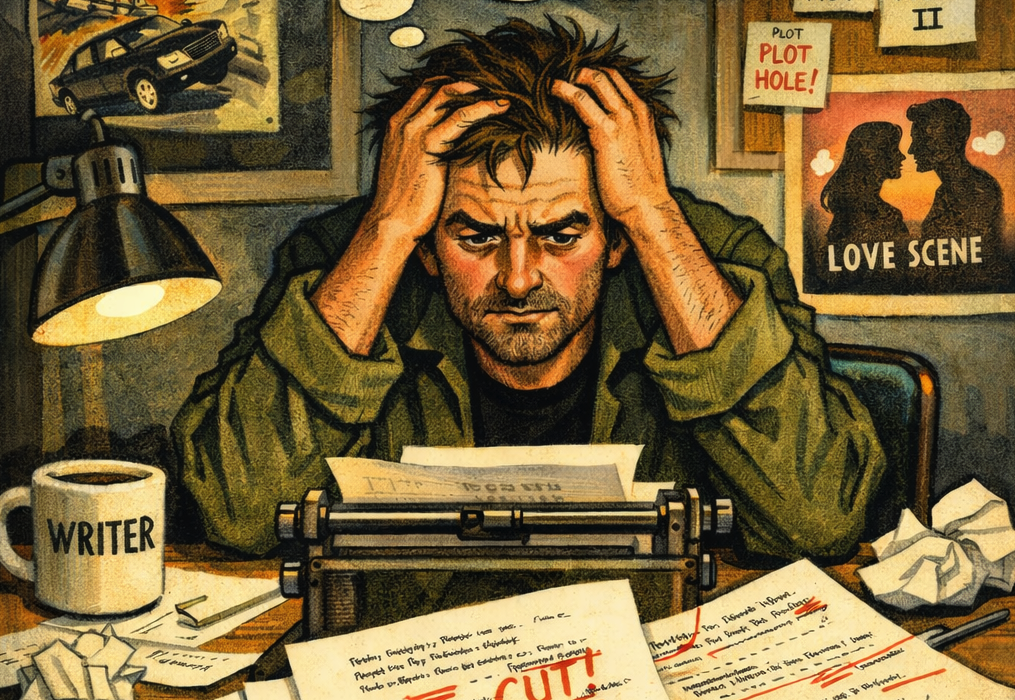
As a screenwriter or story writer, the hardest thing is the rewrite process. You must be able to read your story or screenplay as if you’ve never seen it before. This can seem impossible and overwhelming, but there are methods that can help.
Beware the paragraph becoming a symbol. When you read a sentence or paragraph, instead of actually experiencing it, you let it trigger a pre-made image and emotion in your mind. This could be a memory of what you saw or felt when you first wrote it. Or worse: a memory of how you visualised this part of the story before you even wrote it. The second is far more dangerous, because it means you may not even be communicating to readers what’s in your mind—you’re simply writing down words that trigger your own pre-made images and emotions, images that don’t exist in the paragraph itself.
To avoid this, use meditative reading. Read only the words you see on the page, avoiding any pre-made images. Let the image and sound build in your mind purely from the words, and guard against memories of the story you know so well. After you’ve read the paragraph or scene—what do you see, feel, hear? Be honest.
The second technique is to take a moment and say: I know nothing about this story or screenplay. I am not the writer. I am reading it for the first time. This takes genuine mental and emotional effort, and is avoided by many new or amateur writers. It’s a strange mix of objectivity and emotional openness to experience. But it can be done, or at least approximated.
A third tool: read like you want to stop reading. Most agents, editors, and producers read screenplays and stories to reject them. Your job is to read your story as if you don’t want to read it, as if you want it to be bad so you can quickly move on to something good in your slush pile. This will help you be honest. Would you really bother to continue after the first page? The third page? Does the writing seem professional or amateur? Does it seem like the author put in effort to write this paragraph, or did they write the minimum version of least effort?
The final tool is to avoid being impressed. We tend to be impressed that we managed to write something at all, or impressed by our own cleverness at certain ideas. This causes a false dopamine rush. We’re not getting pleasure purely from the writing, but from the fact that we wrote it. When reading your work, watch for feelings of being impressed with yourself. If they come up, say: this really isn’t as impressive as I think it is, lots of people are able to do this. That may or may not be true, but it will help reduce those false dopamine rushes.
So these are your four tools: hold back your own memories triggered by a paragraph or scene; read meditatively, as if you’ve never seen it before, seeing only the words and avoiding your own thoughts; read like you want to stop reading, assume it’s bad; and don’t be impressed by the fact you wrote this—avoid those false dopamine rushes.
Here’s a guided meditation video on this topic if you want to immerse yourself more deeply in the above processes: https://www.youtube.com/watch?v=N32-eXifm8g